The complete reference — every panel, tracker, and roll helper, in depth. For the short version, head back to the home page; for the story your dice are telling, see your Dice Journey.
Rollwarden hooks D&D Beyond's own dice worker — bonus dice animate and land in the Game Log like any other roll.
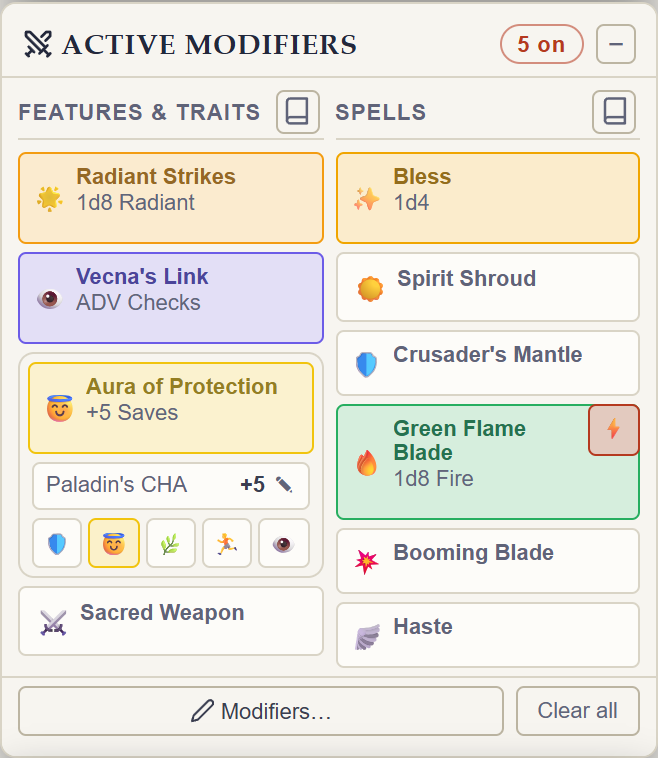
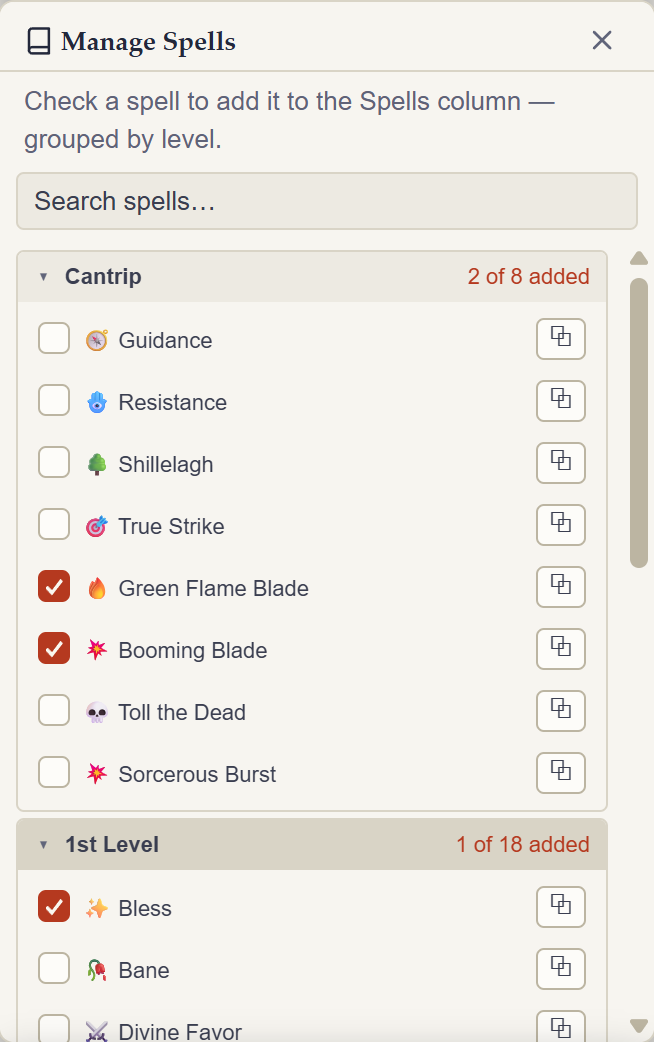
Bless, Divine Favor, Spirit Shroud, Crimson Rite, Haste, Sacred Weapon and more — bonus dice get injected into the matching attack, damage, save, or check automatically.
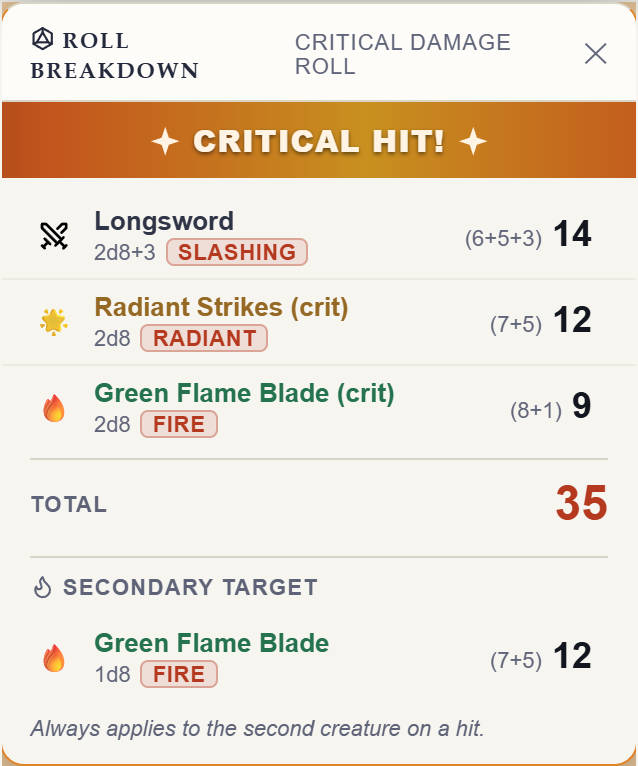
Critical hits double a modifier's bonus dice, detected from a context-menu crit or a natural 20 on the preceding attack. An armed crit shows a chip you can click to cancel before it fires.
Modifiers like Warder's Intuition only fire on the roll types they actually apply to, like Investigation checks.
Vecna's Link, Large Form, Grappled, and Haste automatically force advantage on the saves and checks they affect.
Haste updates AC (+2) and Speed (×2) directly on the sheet the moment it's toggled on.
Rollwarden mirrors your sheet's Exhaustion level and applies your edition's rules automatically — the 2024 per-level penalty or the 2014 ladder, initiative included. Nothing to toggle.
Floating panels that watch your resources so you don't have to — they notice your casts and your damage on their own.
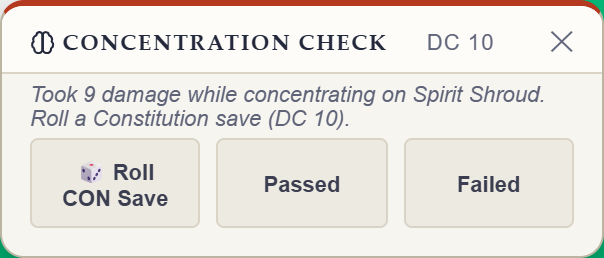
Automatically picks up your active concentration spell when you cast it, and prompts a Constitution save the moment you take damage — DC calculated for you. Roll the save right from the popup and it settles pass or fail on its own.
Built for School of Abjuration wizards: tracks your ward's hit points, shows what an incoming hit should absorb, and recharges when you cast an abjuration spell.
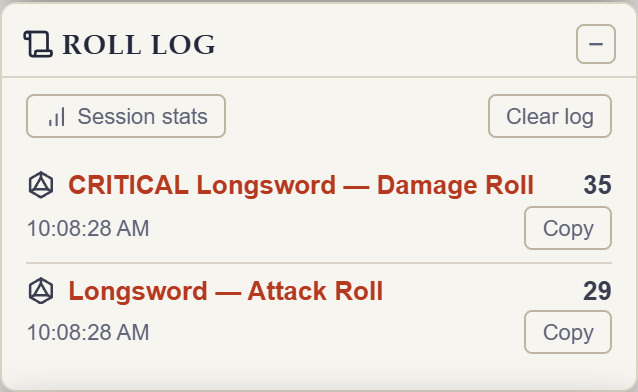
A collapsible history of your and your companions' recent rolls, so "what did I roll two turns ago?" has an answer after the popup is gone. One click copies any entry.
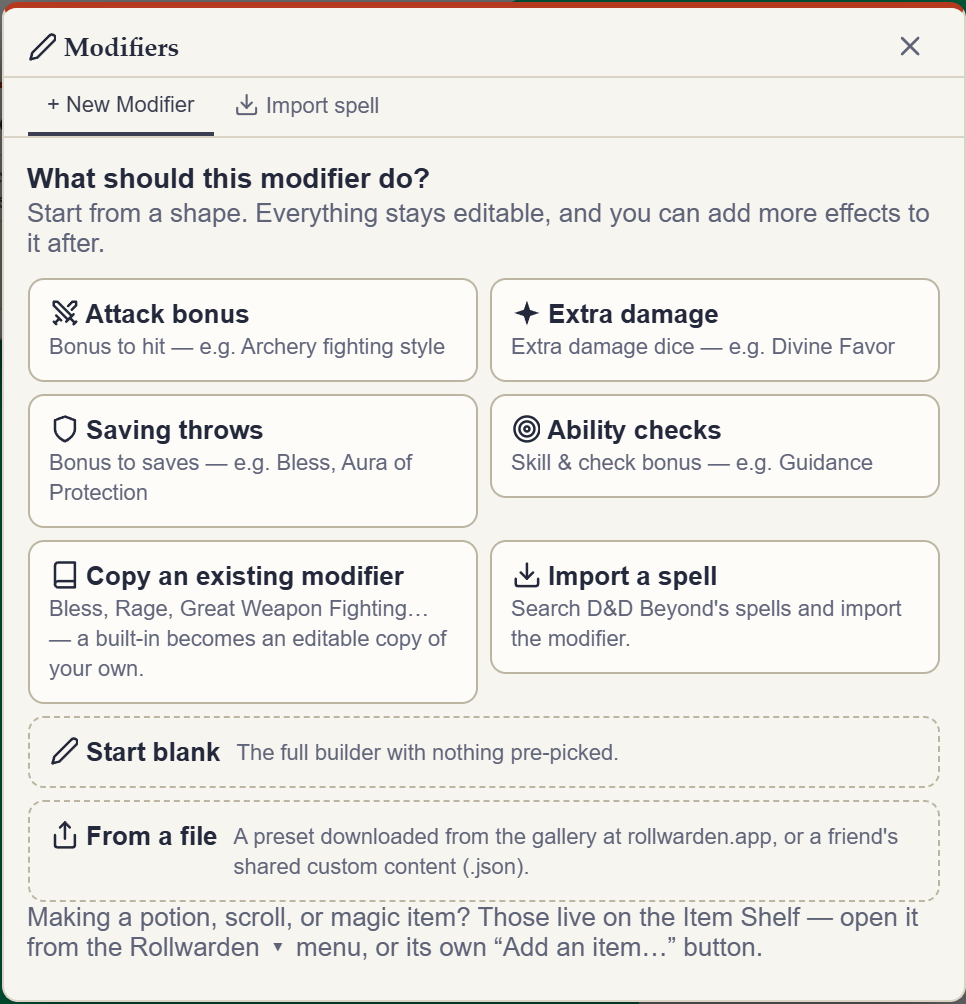
Charged items, scrolls and consumables on a panel of their own: charge pools spent per use (Staff of Power's twenty, a different cost per spell), single-use scrolls, dose-counted potions — dawn regains rolled straight into your log. Build your own from templates, or grab one from the Preset Gallery.
Voice-only Discord table? Roll on your D&D Beyond sheet and the result shows up where everyone's looking — no copying numbers across tabs.
Add a webhook in Settings and every roll lands in your channel with a per-source breakdown — base roll, each active modifier, damage types, and who or what forced advantage. Each character picks which channels its rolls go to.
Tag a webhook GM-only and secret rolls reach just the GM — via a whisper hotkey, or automatically when you use D&D Beyond's own "Send To: Self". Those rolls skip Roll20's table-visible chat entirely.
Spell cards, feature descriptions and sourcebook read-aloud passages carry a Send to table button. It goes wherever your table is — Discord, Roll20, or both — so the DM can drop boxed text into chat without retyping it.
Build on D&D Beyond, play on Roll20. Rollwarden delivers each roll into your Roll20 game as a Roll20 roll — the number D&D Beyond gave you, every die behind it on hover, bonus dice already counted. Your sheet, the Game Log, Discord and the Roll20 table finally say the same thing.
Open a Roll20 game while a sheet is open and Rollwarden offers to connect — once. Say yes and that game reconnects on its own every time it's open; say "not this game" and it won't ask again. Games are listed by campaign name, and the launcher menu shows what you're connected to. Several games at once are fine.
Each roll arrives as a real Roll20 roll carrying D&D Beyond's result — hover it and every die is there, bonus dice included. Roll20 doesn't re-roll anything, so nothing can disagree with your sheet. Prefer Roll20 to roll its own dice for your table? Settings → Integrations → Roll20 → Dice shown in Roll20 switches back.
On either D&D sheet — the classic one and “D&D Fifth Edition (5E & 5.5E)” — rolls arrive as that sheet's own attack, damage, check and spell cards, with a breakdown card underneath naming every modifier that contributed. Rollwarden works out which sheet your game uses by itself, and attributes rolls to your character when the game's journal has one with the same name.
A whisper-hotkey roll or a DM's "TO: DM" encounter roll reaches the Roll20 GM privately instead of not arriving at all. "Send To: Self" rolls stay with you — D&D Beyond hides those from everyone, GM included, so Rollwarden does too.
Initiative can go straight into Roll20's turn tracker — onto your character's own token, with nothing selected over there. If no token carries your name, Rollwarden offers to let you point at your figure once and remembers it. Change your HP or temp HP on D&D Beyond and the linked Roll20 character — and any token bar tied to it — follows. Mark yourself Poisoned and the table sees it in chat and as a status marker on your token. Death saves and inspiration tick across too, at the moment the whole table is watching.
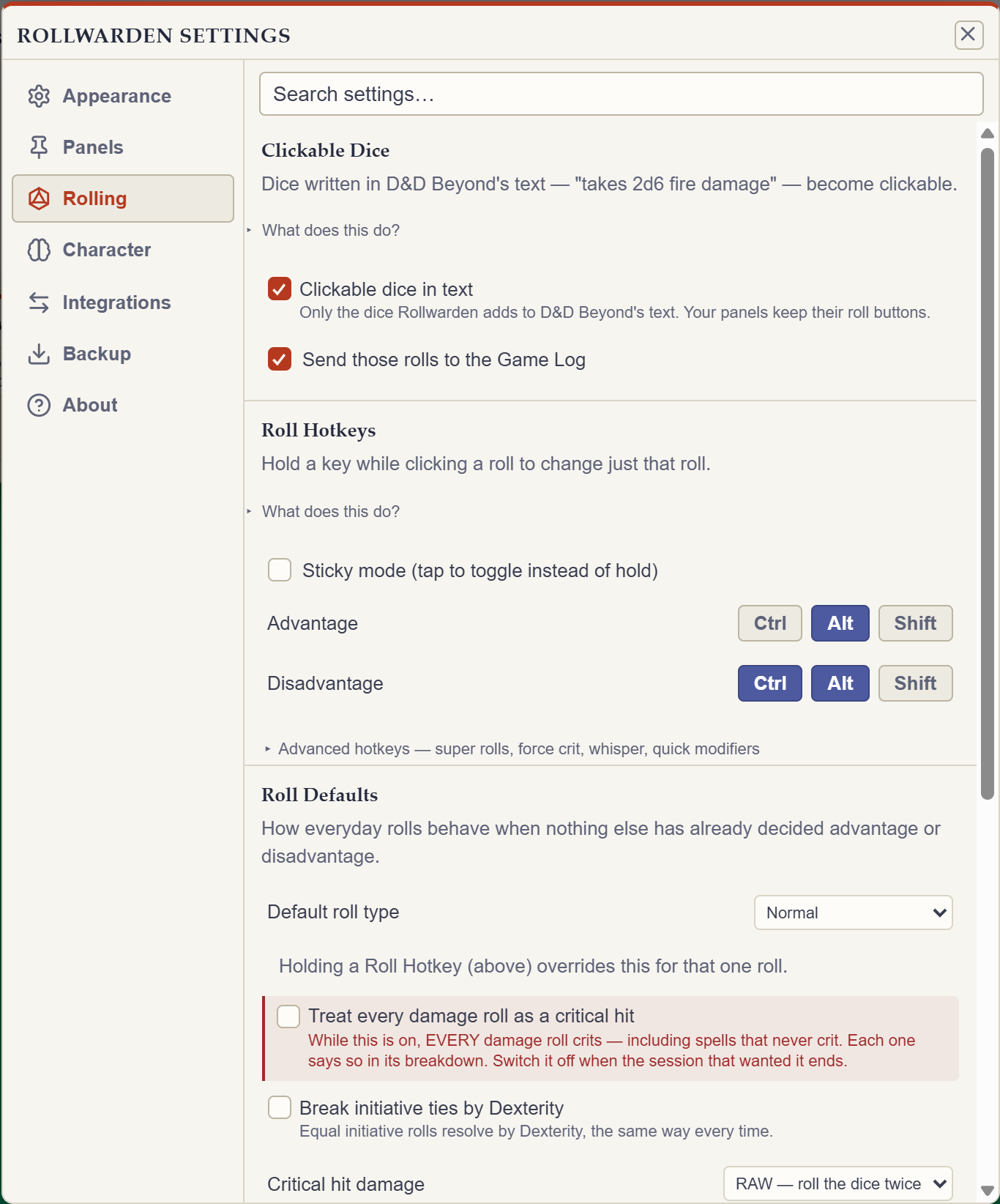
Two 17s in a turn order resolve by however the tracker happened to sort them — differently every combat. Turn on Break initiative ties by Dexterity and your initiative carries a small fraction into Roll20's turn order or Foundry's combat tracker, so the higher Dexterity goes first, always. The fraction is your Dexterity modifier with 10 added to keep it positive, so a +3 becomes .13 and a 17 sorts as 17.13 — which looks like a Dexterity score and isn't one, so the line says which: 17.13 (10 + DexMod[3]). Your roll result stays the whole number. One honest limit: Dexterity 14 and 15 share a +2, so those two still tie.
Roll20's 3D dice only animate for rolls Roll20 itself throws — so if your table likes watching them tumble, flip Settings → Integrations → Roll20 → Dice shown in Roll20 to “Roll20 rolls it live”. Your D&D Beyond number still rides along in the card, named, so nobody has to wonder which one counted.
Both at once, from the same roll: the card lands in your Roll20 chat and the embed lands in your Discord channel, with the same number in both. Whispers stay whispers on each side — the Roll20 GM gets a /w gm, your GM-only channel gets the embed.
Roll initiative in D&D Beyond's Combat Tracker and the same order appears in your Roll20 game, matched to tokens where the names line up — anything you added by hand is left alone. Monster and action names can be hidden from the table ("???") while still saying what kind of roll it was. Both off by default.
Build on D&D Beyond, play on Foundry VTT. Rollwarden delivers each roll into your world as one of Foundry's own rolls — the number D&D Beyond gave you, every die behind it on hover, 3D dice if your table runs Dice So Nice. No module on the Foundry side: the GM's app sees them like any other chat message.
Open your game and click the Rollwarden button on that tab. A small page names the world and offers Always allow on this address — the game then reconnects itself every time you open it — or just this session, which stores nothing at all.
Each roll arrives as a real Foundry roll carrying D&D Beyond's result — hover it and every die is there, advantage's discarded die struck through. Dice So Nice animates the same faces. Foundry re-rolls nothing, so nothing can disagree with your sheet — unless your table prefers Foundry to roll live, which is a setting.
On a world running the D&D 5e system, attacks and checks arrive as its own d20 roll — a natural 20 coloured, advantage labelled — and damage as one typed roll per source, so the card groups damage by type and the GM gets the apply-damage buttons. Any other system gets Foundry's standard roll card.
Change your HP or temp HP and your Foundry actor follows (the maximum stays the system's to compute). Mark yourself Poisoned and the table sees it in chat and as a status icon on your token — cleared when you clear it, and effects you or the GM added are never touched. Death saves and inspiration tick across on 5e worlds. Each write has its own toggle.
Roll initiative and your combatant in Foundry's running combat gets the number — if your actor isn't in yet, its token on the scene joins with it. DMs: the Combat Tracker's turn-order sync reaches Foundry too, matched to tokens by name, with monster names hideable and hand-added rows left alone.
Foundry games are self-hosted, so Rollwarden holds no standing permission on Foundry addresses — it asks for exactly the one address you connect, at connect time, and that grant is listed and revocable under the extension's site access. Secret rolls whisper the Foundry GM; “Send To: Self” rolls stay with you.
Foundry v11–v14, any game system — verified live on v12, v13 and v14. Playing on Roll20 instead? That section is just above ↑
One-roll gestures and standing table rules, so the dice do what your table actually plays.
Hold Alt while clicking a roll for advantage, Ctrl+Alt for disadvantage — just that one roll, no toggles to forget. Rebindable, with super-advantage and whisper keys and a tap-to-arm sticky mode.
Maxed crit dice, or "double what you rolled"? Set it once and every critical follows your table's rule — whether Rollwarden detects the nat 20 or you click D&D Beyond's own Crit Damage.
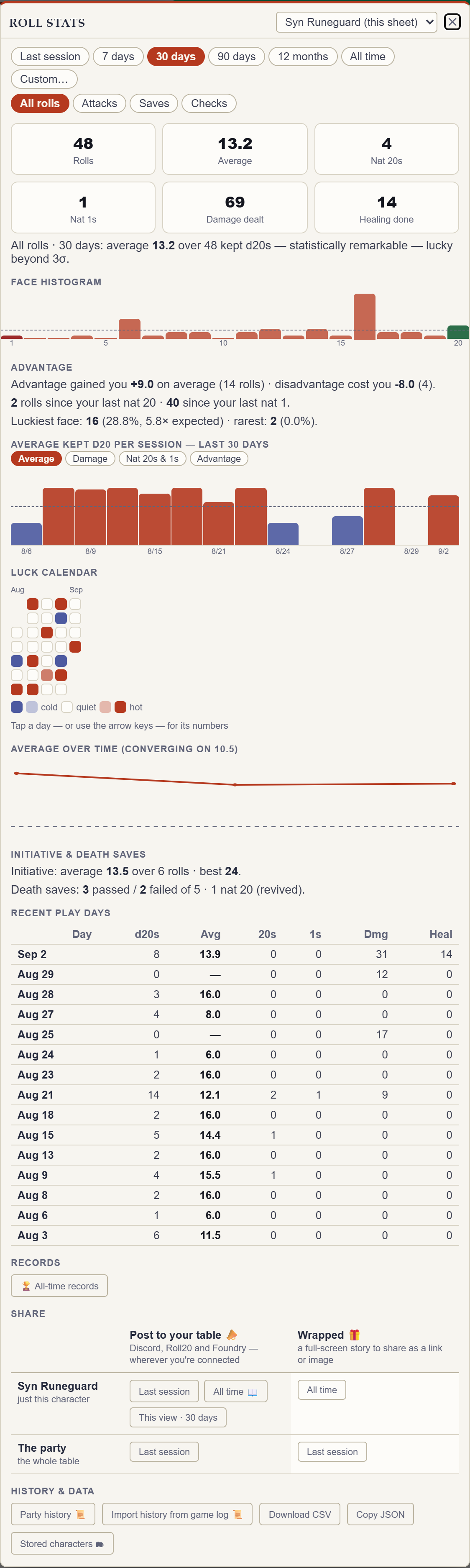
"Takes 2d6 fire damage" in a monster description becomes a rollable button — on monster, spell, item, and sourcebook pages, and in descriptions on your own sheet. Sourcebook tables get a Roll button of their own: it rolls the die, finds your row, and can send it to your table. Rolls stay local, or opt in to send them to the Game Log.
Active modifiers, custom content, companions, and trackers save separately for every character sheet — your wizard's setup never bleeds into your barbarian's.
Deleting a custom modifier or companion, clearing all toggles, importing a backup, resetting settings — everything destructive shows an Undo instead of just happening.
A three-step welcome tour points at the real thing on your own sheet, then ends with your own roll — toggle a modifier, roll D&D Beyond's dice, and it celebrates when the bonus lands. Nine more steps wait behind an optional button, and panels and popups are keyboard- and screen-reader-friendly.
From Scriptorium in the light to Inkwell in the dark, each theme is picked from a swatch painted in its own real colours — or leave it on auto and Rollwarden follows your browser's light and dark.
Any screenshot on this page can be clicked to view full-size.
Install Rollwarden from the Chrome Web Store and your next session's modifiers, crits, and companion rolls handle themselves.
Install on Chrome